
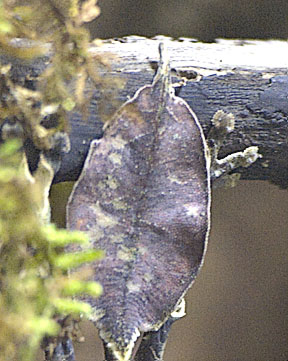
The Gecko's Foot
But the real wonder about the Leaf-tailed gecko is not his his camouflaged leaf-tail but his foot. It sticks to anything, including glass.
A gecko that is as large as a foot long has such adhesive power in its feet that it can run upside down on a pane of glass. And the adhesion to the glass is so strong that it can support a 250 pound man!
The dime-sized feet of a Tokay gecko pack enough sticking power to suspend a 250-pound man from a ceiling. They enable the 12-inch lizard to scale walls at breakneck speed or saunter upside-down across a plate of glass. A gecko can stick to the molecularly smooth surface of a silicon wafer. It will hold fast underwater and in a vacuum. It can attach and detach its toes with ease, and its feet never stick to each other or clog with sand and dirt. University of Minnesota News, March 20, 2008 (referencing research conducted by Tony Gamble for the Bell Museum)
What causes this amazing ability? According to the above quoted article, only recently have scientists been able to determine how the gecko has such amazing adhesion.
The gecko's foot is not sticky, like adhesive tape or glue, nor does it contain suction cups. The amazing adhesion of the gecko's foot can be explained only by means of nano-technology that addresses the electro-molecular forces that exist between molecules. In order for the molecules of a living thing to take advantage of these molecular forces, the living thing must possess parts that are small enough.
A gecko’s foot has toepads consisting of about half a million setae made of keratin. Each of these fine hairs has hundreds of even smaller projections of nanoscale diameters called spatulae protruding from their ends.
http://web.stanford.edu/group/mota/education/
Physics%2087N%20Final%20Projects/Group%20
Gamma/gecko.htm
Each setai is 1/10 the diameter of a human hair. Each spatula is a spoon shaped area that is approximately .02 microns wide. Each of these microscopic appendages create a minute electrostatic molecular bonding with the molecules of a surface. The bonding forces that bind the spatulae to a surface are called Van der Waals forces. See Kellar Autumn; Metin Sitti ; Yiching A. Liang; Anne M. Peattie; Wendy R. Hansen; Simon Sponberg; Thomas W. Kenny; Ronald Fearing; Jacob N. Israelachvili; Robert J. Full. Evidence for van der Waals adhesion in gecko setae. Proceedings of the National Academy of Sciences of the USA 2002, 99, 12252-12256. doi:10.1073/pnas.192252799; also see the above quoted article published by the University of Minnesota.
Van der Waal forces are imperceptible except on the molecular level, hence in order to be effective there must be millions of microscopic spatulae on the gheko's foot. They form an adhesion that is orders of magnitude more effective than conventional adhesive tape - and yet they are instantly released by simply changing the angle of force. So, a gecko equipped with these appendages on the bottom of its feet can literally run on a pain of glass upside down.
Follow the following link to see a photograph of the gecko's foot:
But Van der Waal's forces in a gecko's foot are useless without a sufficient number of them. Just a few spatulae will not do it. There must be millions in order to be effective. So the gecko's foot could not have evolved incrementally. All of the requisite spatulae have to be in place in order for there to be a beneficial effect on survival.
What is the evolutionist's explanation? Tiny, primitive gecko-like animals (reptiles) that did not need as many spatulae on their feet by sheer accident mutated not millions but only thousands of nano-spatulae that happend to coincide with Van der Waals forces--just enough to support their tiny bodies. These nano-spatulae increased their ability to survive. Then they accidentally mutated into larger animans and mutated millions of additional nano-spatulae, all of which were equally compatible with Van der Waals forces. Eventually we end up with a foot long gecko that can run upside down on a pane of glass.
That explanation is pure imagination.
Evolutionists presume evolution to be true and then they imagine a scenario that fits it. Then they teach it as fact.
And did this development continue on a parallel course with the leaf-tail pictured above until these appendages "discovered" what Van der Walls forces could do and the tail became an almost perfect representation of a wilted leaf? Is that really what happened?
And what environmental force decided to go on and create a foot adhesion that was 250 times more effective than necessary?
The only thing that environmental pressures can do to geckos is kill them. There is no evidence whatever that mutations really do things like create nano-tissues that employ nano-technology.
The real reason for the evolutionists' explanation is this:
Even if there were no actual evidence in favor of the Darwinian theory ... we would still be justified in preferring it over rival theories [creationism]. Richard Dawkins, The Blind Watchmaker (NY Norton, 1986), 287, emphasis in the original
Darwinism will always be the explanation no matter what the observed facts show. Creationism cannot be considered because creationism implies that there is a Creator and Creators will not be permitted to exist.
The truth, however, is that the foot of the gecko was intelligently designed with the purpose of utilizing Van der Waals forces. An objective assessment of what is observed points to a design made by a Designer who was aware of Van der Waals forces before the foot of the gecko was ever constructed.
see the uroplatus gecko and its amazing camouflage.